

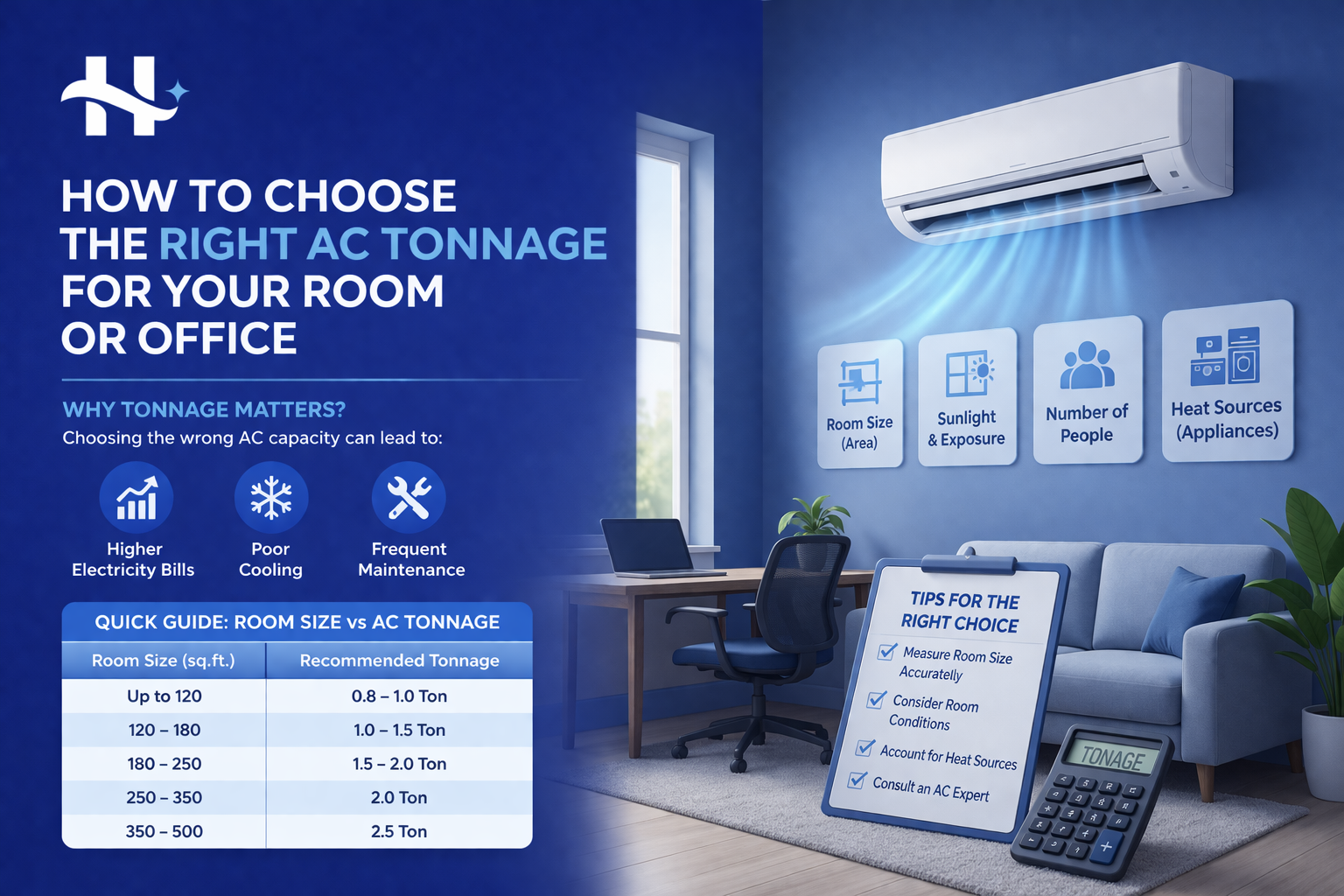
Selecting the correct AC tonnage is one of the most important decisions when installing an air conditioning system. An undersized AC will struggle to cool the space, while an oversized unit will lead to higher energy consumption and uneven cooling.
Whether it’s a small room or a large office, choosing the right tonnage ensures optimal performance, comfort, and long-term cost savings.
What Does AC Tonnage Mean?
AC tonnage refers to the cooling capacity of an air conditioner—not its weight. One ton of AC is equivalent to the ability to remove 12,000 BTUs (British Thermal Units) of heat per hour. The higher the tonnage, the larger the area it can effectively cool.
Key Factors That Affect AC Tonnage Selection
1. Room or Office Size
The size of the space is the primary factor. Larger areas require higher tonnage for effective cooling.
General Guideline:
- Up to 120 sq. ft. → 1 Ton
- 120–180 sq. ft. → 1.5 Ton
- 180–300 sq. ft. → 2 Ton
2. Ceiling Height
Rooms with higher ceilings have more air volume, requiring additional cooling capacity. Standard calculations assume a ceiling height of around 10 feet.
3. Number of Occupants
More people generate more heat. Offices or meeting rooms with higher occupancy may need higher tonnage than standard recommendations.
4. Sunlight Exposure
Rooms that receive direct sunlight, especially in cities like Rajkot, heat up faster and may require a higher capacity AC.
5. Electrical Equipment & Appliances
Offices with computers, servers, or heavy equipment generate additional heat, increasing cooling requirements.
Simple Formula for Estimation
You can use a basic formula for rough estimation:
Tonnage = (Room Area in sq. ft. × 0.0016)
This gives a starting point, but adjustments should be made based on the factors mentioned above.
Common Mistakes to Avoid
- Choosing Lower Tonnage to Save Money: Leads to poor cooling and overworking the AC
- Overestimating Tonnage: Results in higher electricity bills and frequent on/off cycles
- Ignoring Room Conditions: Sunlight, insulation, and occupancy matter
- Not Consulting Experts: Wrong sizing can reduce system lifespan
Expert Tips for Accurate Selection
- Always round up slightly if your room gets heavy sunlight
- Use energy-efficient (5-star rated) AC units for better savings
- For offices, consider future expansion while selecting tonnage
- Get a professional load calculation for precise results
When to Call a Professional
If your space has complex requirements—like multiple rooms, glass facades, or heavy equipment—it’s best to consult an HVAC expert. Professionals use detailed load calculations to recommend the exact tonnage needed.
Conclusion
Choosing the right AC tonnage is essential for achieving efficient cooling, lower energy bills, and long-lasting performance. By considering room size, occupancy, sunlight, and usage, you can make a well-informed decision.
When in doubt, always seek expert advice to ensure your investment delivers maximum comfort and efficiency.
FAQs
1. What happens if I choose a lower tonnage AC?
It will struggle to cool the space, run continuously, and increase electricity consumption.
2. Is higher tonnage always better?
No, oversized ACs lead to inefficient cooling and higher energy costs.
3. Can I use 1.5 ton AC for a small room?
Yes, but it may result in unnecessary power consumption and uneven cooling.
4. How important is ceiling height in AC selection?
Very important, as higher ceilings increase the cooling load.
5. Should I consult a professional before buying an AC?
Yes, especially for offices or large spaces, to ensure accurate tonnage selection.